Drop Shipping Automation: from request to live listing.
A print-on-demand shop run by a team of nine AI agents. A request enters the pipeline, and the agents carry it through concept, design, copy, publishing, website sync, and promotion until the product is for sale, with no one moving files or copying text between tools.
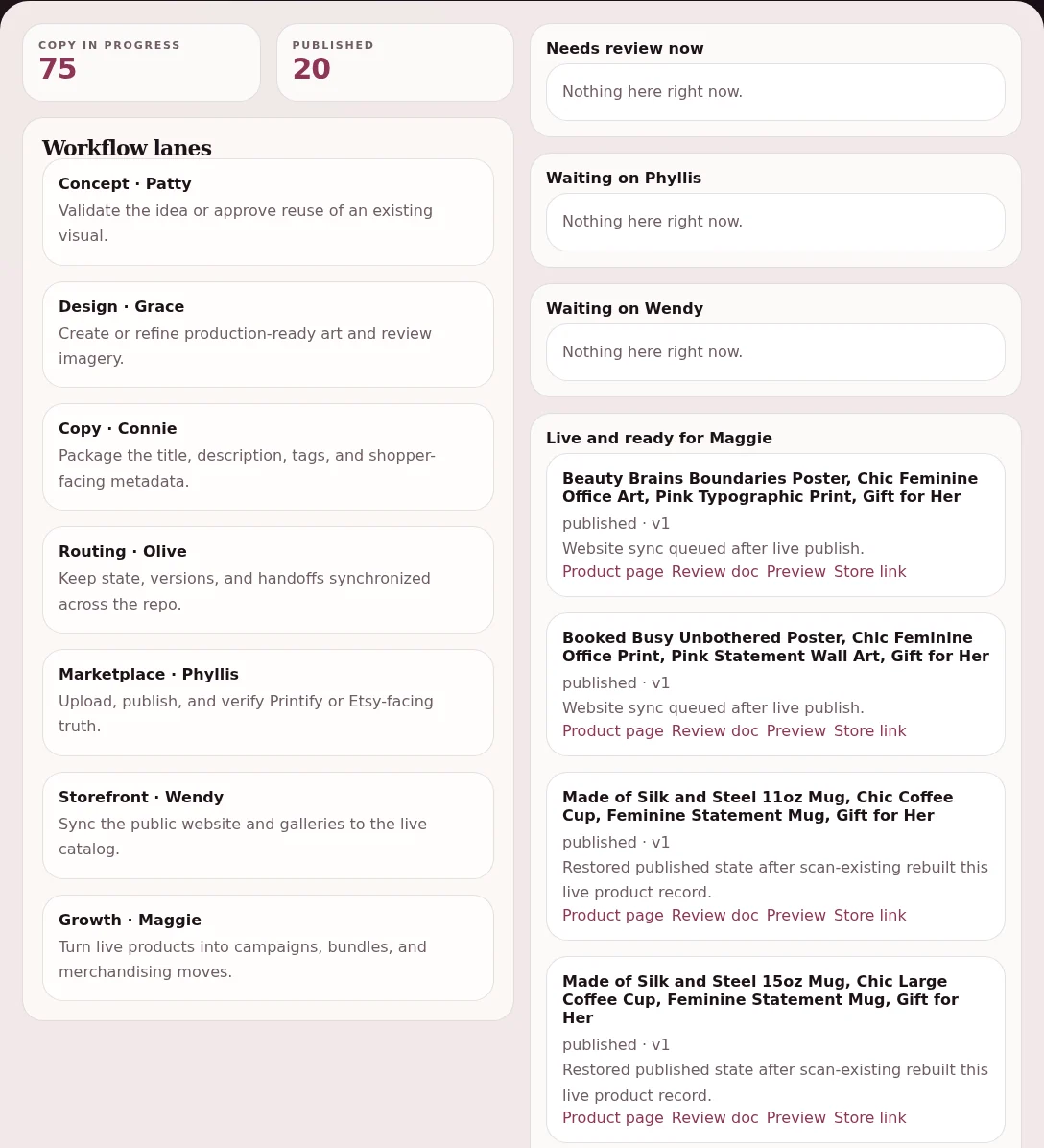
About this project. Unlike Sprint Ledger, this system is live: the products it produces are for sale. The figures below come from a snapshot of its Mission Control dashboard taken on 19 June 2026. Mission Control is internal, so it appears here as screenshots with network details removed.
- Project
- Drop Shipping Automation, an agent-run online shop
- Business
- Velvet Static, a print-on-demand shop for statement gifts and apparel
- Model
- Print-on-demand drop shipping through Printify, sold on Etsy and on a companion website
- Agents
- Nine, each with one job and written inputs and outputs
- Pipeline
- Seven lanes, from concept through to promotion
- Oversight
- Mission Control, an internal dashboard of queues, agents, and history
- Status
- Live: 20 products for sale at the 19 June 2026 snapshot
One request in, a live product out.
Each stage belongs to one agent, and each agent hands finished work to the next. A product never waits for a person to move it along.
- RequestThe owner, or Patty’s trend research
- ConceptPatty validates the idea
- DesignGrace makes production art
- CopyConnie writes the listing
- Route and packageOlive tracks state and hand-offs
- PublishPhyllis creates and verifies the product
- WebsiteWendy syncs the storefront
- PromoteMaggie starts the sales push
Two agents sit outside the line. Beatrice sets the brand standard that every stage is measured against and makes the final call on what belongs in the catalog, and Scanner rebuilds the workflow’s records from the files on disk when they need repair.
The owner’s part is deliberate and small: raise a request, approve what lands in the review queue, and adjust the standard. Everything between the request and the live listing, including creating the product in Printify and placing it on the website, is done by the agents.
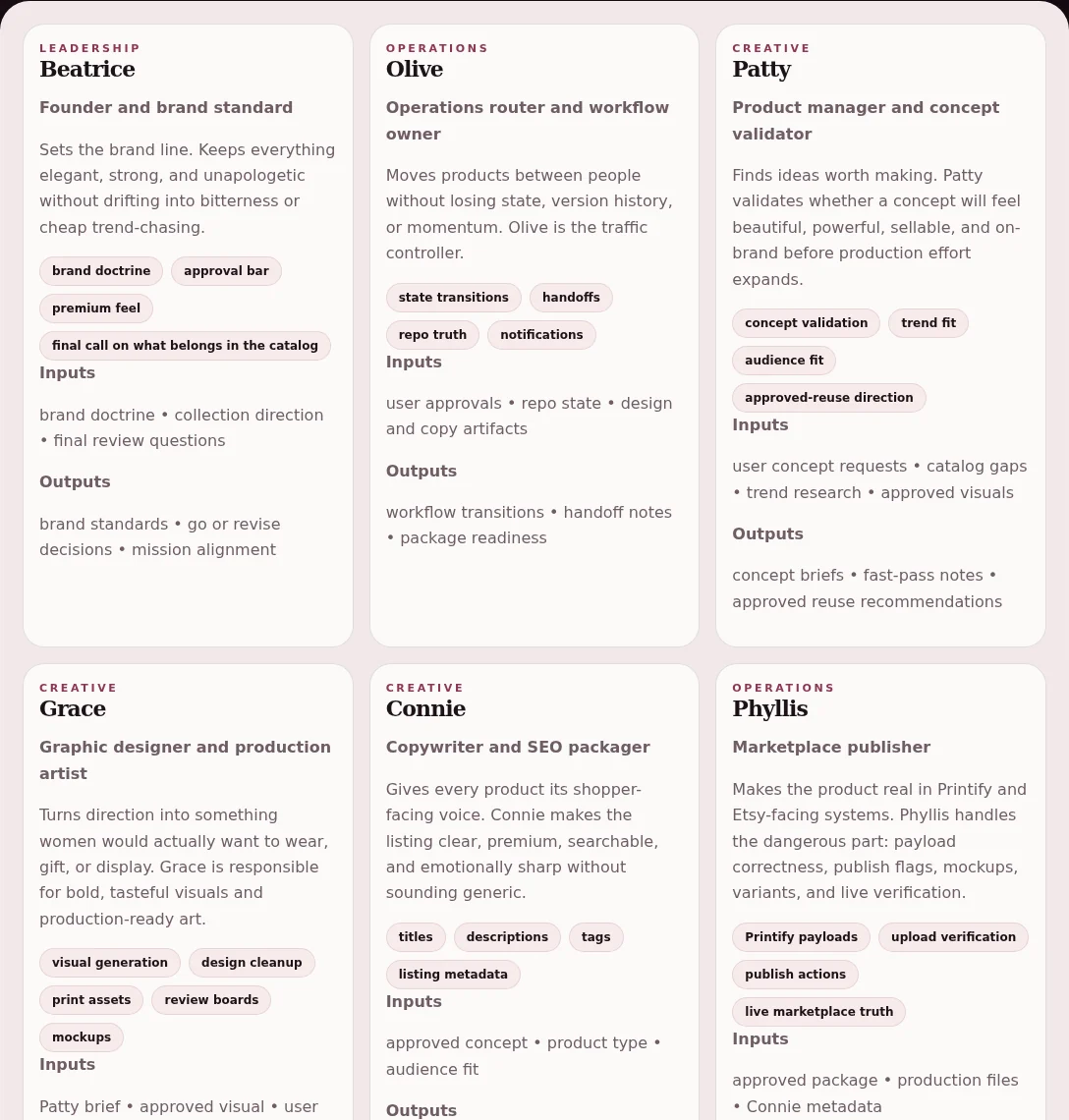
Nine agents, one job each.
Every agent has a written role, a defined input, and a defined output. That is what makes the hand-offs reliable: an agent knows what it will receive and what it must return.
| Agent | Role | Takes in | Produces |
|---|---|---|---|
| Beatrice | Founder and brand standard | Brand doctrine, collection direction, final review questions | Brand standards and go-or-revise decisions |
| Olive | Operations router and workflow owner | Approvals, repository state, design and copy files | Workflow transitions, hand-off notes, package readiness |
| Patty | Product manager and concept validator | Concept requests, catalog gaps, trend research, approved visuals | Concept briefs and reuse recommendations |
| Grace | Graphic designer and production artist | The concept brief, an approved visual, revision notes | Production files, review mockups, revisions |
| Connie | Copywriter and SEO packager | The approved concept, product type, audience | Titles, descriptions, tags, listing metadata |
| Phyllis | Marketplace publisher | The approved package, production files, Connie’s metadata | Printify products, publish results, live listing state |
| Wendy | Storefront sync owner | Published products, live listing images, marketplace links | Updated website pages, galleries, and sitemap |
| Maggie | Post-launch marketing and merchandising | The live URL, final images, current pricing, collection placement | Campaign ideas, bundles, channel-ready promotion |
| Scanner | Repository state rebuilder | Repository files, existing hand-offs, package manifests | Restored product records and rebuilt workflow history |
State, versions, and hand-offs.
Every product is a record in a repository with a current state and a version number, so a revision creates a new version and the history stays intact. Each hand-off writes an event to a ledger: a package is built, files are attached, and the state changes. At the snapshot the ledger held 2,886 events, and Olive alone had recorded 376 of them.
The last three hand-offs of a poster recorded in the ledger show the shape of the end of the pipeline:
- OliveForwards the finished production asset and a 13-tag listing package to the publisher. State: sent to Phyllis.
- PhyllisCreates the Printify product hidden first and verifies the upload response before going further. State: uploaded to Printify.
- WendyQueues the website sync after the live publish. State: published.
Work waiting on a person or on another agent sits in named queues: needing review, waiting on the publisher, and waiting on the storefront agent. A product that is live and has its website page becomes ready for Maggie, whose work begins only then.
The result is a real storefront.
The pipeline ends in public places: listings on Etsy and matching pages on the shop’s own website, kept in step by the storefront agent.

Seeing the whole system at a glance.
Mission Control is a static dashboard rebuilt from the repository’s state, memory, assets, documents, events, and scheduled jobs. It shows the queue counts, the agent roster, the workflow board, the asset catalog and mockup packs, and an event timeline. Its memory ledger hides secret details by design, so the dashboard can be shared without exposing credentials.
What the system had produced.
| Measure | At the snapshot |
|---|---|
| Products tracked | 95 |
| Live listings | 20: 11 posters, plus mugs, a cosmetic bag, a crewneck, a glass can, a journal, a laptop sleeve, a phone case, and a tee |
| Sticker concepts in the copy stage | 75 |
| Listing packages built | 192 |
| Mockup packs | 66 packs holding 441 images |
| Recorded events | 2,886, including 789 state transitions |
| Agent-written documents | 500 briefs and hand-offs: 299 from the publisher, 98 from the copywriter, 75 from the concept manager, and 18 from the designer |
| Scheduled jobs | 2: sitemap upkeep every six hours and a credential check every twelve hours |
Figures are from the Mission Control snapshot taken on 19 June 2026.
Five choices that make it dependable.
One owner for every stage.
Each agent has one job and a written input and output. When something goes wrong, there is one place to look, and no two agents can quietly do the same work.
The repository is the source of truth.
State, versions, and hand-offs live in the repository, not in any agent’s head. Scanner can reconstruct product records and workflow history from the files on disk, and it has already restored published products this way.
Publish carefully, then verify.
The publisher creates each product hidden first, checks the upload response, and only then publishes, before confirming what is live on the marketplace. The step that touches the outside world is the one with the most checks.
A written standard is the approval bar.
Every launch has to pass the same five written questions about brand fit. Because the bar is explicit, the agents can apply it consistently, and a person can change it in one place.
The loop stays closed after launch.
The storefront agent brings the website in line with the live listing, and marketing starts only once the product is live and its public pages are current. Scheduled jobs keep the sitemap fresh every six hours and check the credentials used for social posting every twelve.
Agents with roles, not one assistant.
The system splits a business process into specialist AI roles, each with a written brief, defined inputs and outputs, and a single stage to own. The value comes as much from the workflow design, with its hand-offs, states, queues, and checks, as from any one agent.